A typical atom has a characteristic diameter of roughly 0.1–0.3 nanometers. Explore what that means without a planetary orbit model.
An atom has no hard painted edge
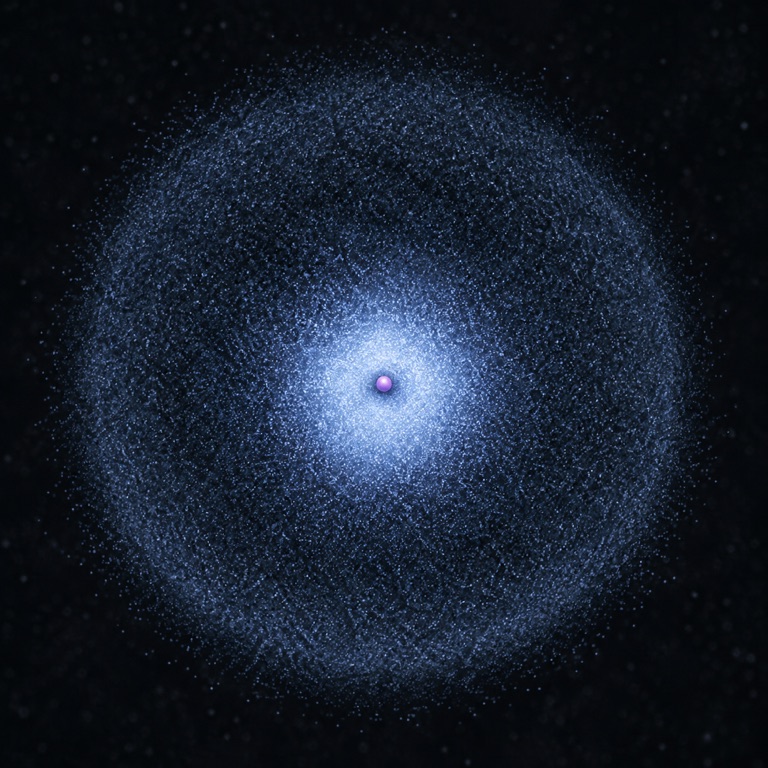
A cloud has a dense centre and a fuzzy edge. An electron-cloud picture also uses a spread-out pattern, but it represents the chance of finding an electron. It is not a photograph of fog or a little planetary orbit.
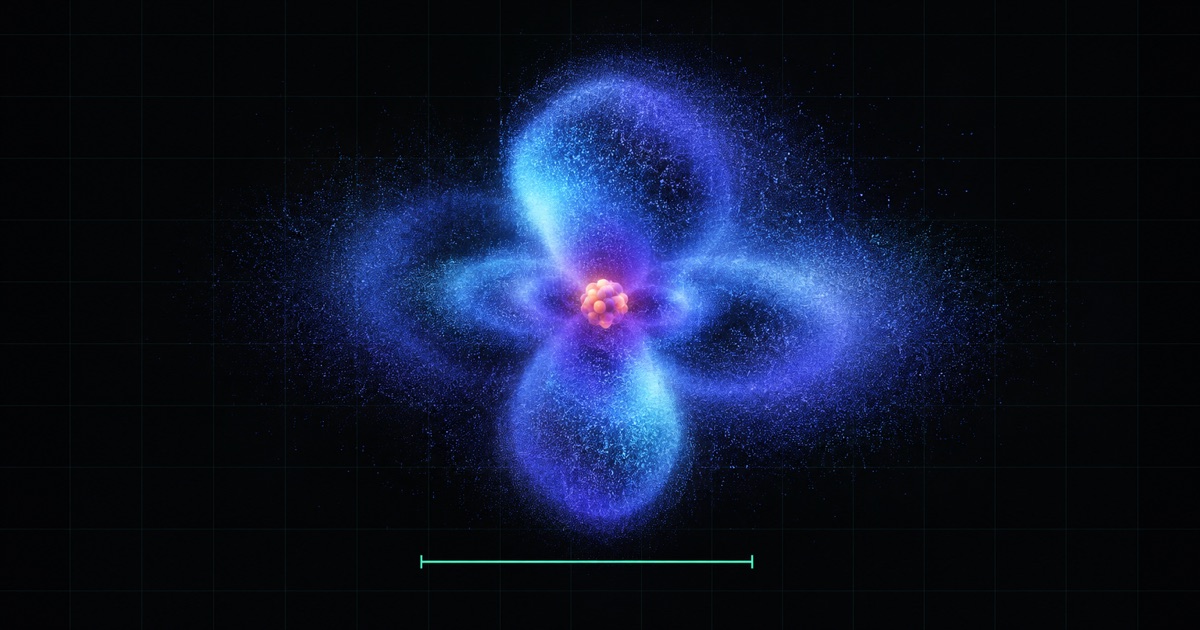
An illustration for recognizing the subject. Read the adjacent diagram for the stated scale.A schematic probability cloud: darker dots indicate greater probability density. The centre and cloud are not drawn to a common nuclear/atomic size scale. The Bohr radius is a useful characteristic length.
Work it out, one step at a time
Read a very small length in a convenient unit
0.0529 nm × 1,000 = 52.9 pm
These rounded values describe the Bohr radius, not a hard outer surface.
Ask what was measured
1 pm = 0.001 nm
Atoms can have different radius definitions. A different definition can give a different number.
Words made simple
Characteristic length
A length that helps describe how a physical system behaves.
Think about it: Does the coloured cloud boundary act like a glass wall?
No. It is a display choice for a probability distribution. Read the measurement definition before comparing radii.
Where the numbers come from: NIST · NIST. The illustration and worked model are made for this lesson; assumptions are stated above.
Compare with another scale
Build a scale model of any two lengths
Choose from all 71 Macro and 54 Micro references, or enter your own length. Set B’s model length and see A change on the same fixed metre ruler. The bars represent the stated lengths, including their different measurement definitions.
Length ratio A / B
Model length B
Calculated model length A
Fixed scale: 1 m uses 250 drawing units. Moving the model-size slider changes the bar lengths, while the real measurements stay fixed. Full ratio view: the longer length fills the width. Sub-pixel lengths retain their computed width; read the numerical ratio for very different scales.
A · Typical atom
150 pm
Characteristic length under a stated convention, not necessarily a diameter.
The existing visualizer retains this educational comparison. Its numerical value is withheld from this distribution until its precise definition and primary evidence are checked.
This calculator uses the existing journey comparison inputs. Review-pending or conceptual entries remain illustrative inputs here; the public reviewed dataset keeps their numeric values withheld. Radius, height, diameter and experimental bound keep their individual definitions.
An atomic length and a proton radius answer different questions
The Bohr radius a₀ divided by the proton RMS charge radius is approximately 62,941. Choosing 2a₀ doubles the numerical ratio. This is a comparison of stated length definitions, not a picture of two hard spheres.
Atomic length (m)
Proton RMS charge radius (m)
8.4075e-16 m
Stated length ratio
a₀ = 5.29177210544 × 10⁻¹¹ m rp = 8.4075 × 10⁻¹⁶ m ratio = selected atomic length / rp
Keep the physical definitions beside the arithmetic
a₀ is an atomic-model characteristic length associated with electronic structure. The electron distribution is diffuse and atomic size conventions depend on state and environment. The proton value is the RMS radius of its charge distribution, constrained by scattering and spectroscopy. Multiplying a charge radius by two supplies a numerical length convention, not a hard outer diameter. Cubing these ratios would not establish a fraction of an atom that is “empty”.
2022 CODATA standard uncertainties: u(a₀) = 8.2 × 10⁻²¹ m, u(rp) = 6.4 × 10⁻¹⁹ m. This activity displays central-value arithmetic only and does not propagate their uncertainties or correlation. The existing Micro journey uses a rounded 2a₀ length of 1.06 × 10⁻¹⁰ m; the present calculation retains the published central a₀ value.
Atoms have no hard outer surface. A few tenths of a nanometer—roughly 0.1–0.3 nm—is a useful characteristic diameter for comparing their diffuse electron distributions.
Representative value150 pm
In meters1.5 × 10⁻¹⁰ m
Measurement typeCharacteristic length
Put it in context
What are we measuring at this scale?
The apparent size depends on the atom and on how size is defined in a bond, crystal or isolated quantum system. ScaleTrip therefore labels the value as a characteristic length rather than a rigid diameter.
Compare the related scales
These ratios divide the displayed representative lengths. Unit markers, diameters, characteristic lengths and charge radii describe different measurements; read each ratio as a length comparison using those measurement definitions.