The DNA double helix is about 2 nanometers in diameter. Compare that width with proteins, cell membranes and atomic dimensions.
Give a blood cell a 3.75 m width; DNA becomes 1 mm wide
A red blood cell’s width and a DNA double helix’s width are very different. First express both in nanometres. Then the comparison is ordinary division.
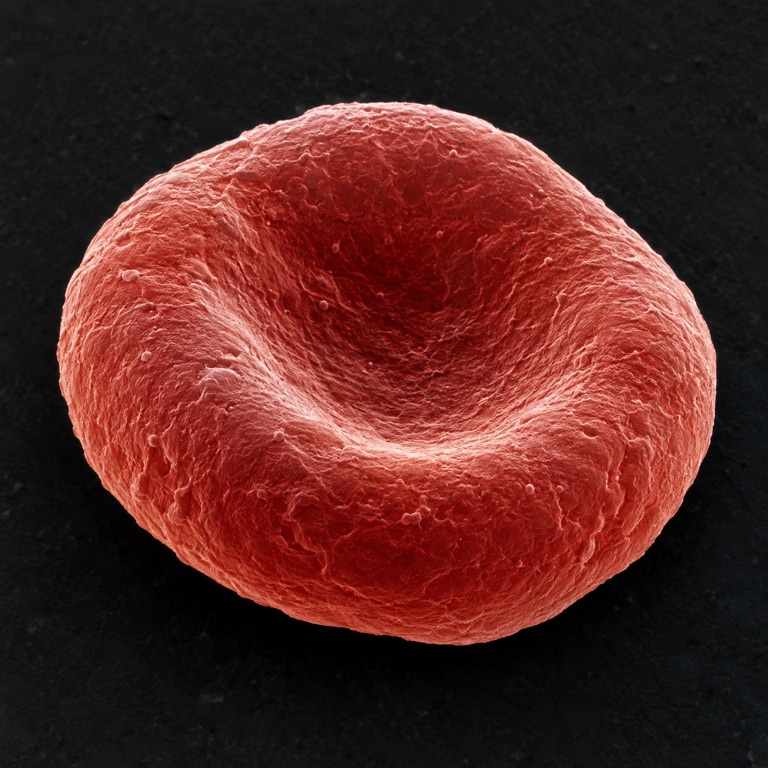
An illustration for recognizing the subject. Read the adjacent diagram for the stated scale.Selected widths: red blood cell 7,500 nm, DNA 2 nm. In the model the cell’s width is 3.75 m and DNA’s width is 1 mm. The two enlarged pictures below are separate close-ups, not a common scale.
Work it out, one step at a time
Use the same unit
7.5 µm × 1,000 = 7,500 nm
One micrometre contains 1,000 nanometres.
Divide the larger width by the smaller
7,500 ÷ 2 = 3,750
This is a width ratio. It does not count how many DNA molecules fit inside a cell.
Words made simple
Diameter
The width across an object through its centre.
Think about it: If DNA is 2 mm wide in your model, how wide is the cell?
2 × 3,750 = 7,500 mm, or 7.5 m. Both lengths must grow together.
Where the numbers come from: NHGRI · Fung, Tsang & Patitucci (1981). The illustration and worked model are made for this lesson; assumptions are stated above.
Build a scale model of any two lengths
Choose from all 71 Macro and 54 Micro references, or enter your own length. Set B’s model length and see A change on the same fixed metre ruler. The bars represent the stated lengths, including their different measurement definitions.
Length ratio A / B
Model length B
Calculated model length A
Fixed scale: 1 m uses 250 drawing units. Moving the model-size slider changes the bar lengths, while the real measurements stay fixed. Full ratio view: the longer length fills the width. Sub-pixel lengths retain their computed width; read the numerical ratio for very different scales.
A · DNA double helix
2 nm
Approximate DNA double-helix diameter (NHGRI transcript question 296).
Source claim checked
A transverse diameter, rather than the total length of a DNA molecule.
This calculator uses the existing journey comparison inputs. Review-pending or conceptual entries remain illustrative inputs here; the public reviewed dataset keeps their numeric values withheld. Radius, height, diameter and experimental bound keep their individual definitions.
The DNA double helix is about 2 nm in diameter. This value describes its width; the length of a DNA molecule depends on how many base pairs it contains and how it is packaged.
Representative value2 nm
In meters2 × 10⁻⁹ m
Measurement typeTypical diameter
Put it in context
What are we measuring at this scale?
Two nanometers is twice the one-nanometer marker and many times a characteristic atomic dimension. DNA has molecular structure, which the illustration highlights through its double helix.
Compare the related scales
These ratios divide the displayed representative lengths. Unit markers, diameters, characteristic lengths and charge radii describe different measurements; read each ratio as a length comparison using those measurement definitions.