Human scalp hair is commonly tens of micrometers across. Explore a representative 50–100 µm range and see why hair diameter varies.
A hair can look narrow from one direction and wide from another
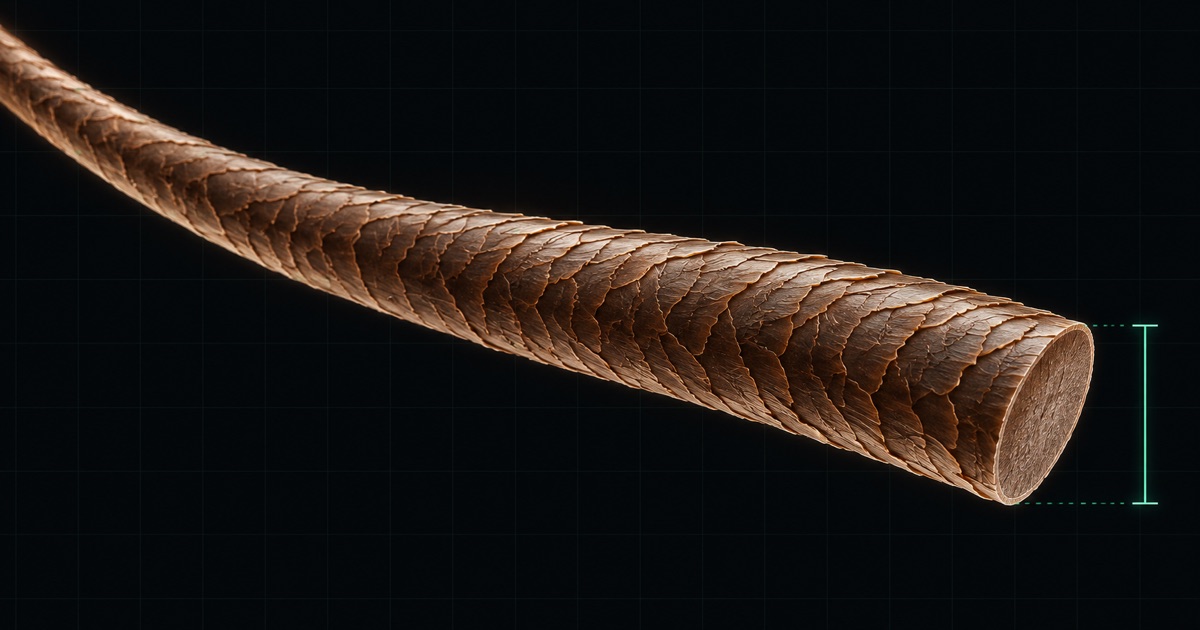
Think of looking at an oval pencil from different sides. A hair’s cross-section can be oval too. One width is not always enough to describe the strand.
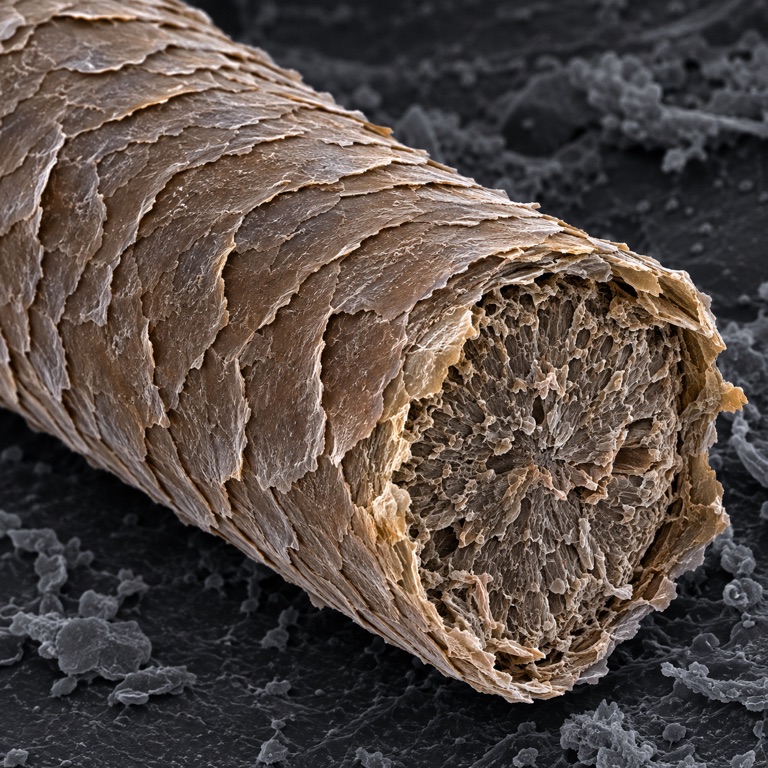
An illustration for recognizing the subject. Read the adjacent diagram for the stated scale.The arrows show two widths of an oval cross-section. This is a shape diagram. The 80 µm value is a chosen comparison, not a measurement of your hair.
Work it out, one step at a time
Change micrometres to nanometres
80 × 1,000 = 80,000 nm
This chosen width makes the arithmetic easy; real strands vary.
Compare with a 2 nm DNA width
80,000 ÷ 2 = 40,000
The chosen hair width is 40,000 times the chosen DNA width.
Words made simple
Representative value
A selected useful example; it is not true for every specimen.
Think about it: If the chosen hair width is 100 µm, does the DNA ratio stay 40,000?
It becomes 100,000 ÷ 2 = 50,000. A different input gives a different result.
Where the numbers come from: van den Berg et al. · NHGRI. The illustration and worked model are made for this lesson; assumptions are stated above.
Compare with another scale
Build a scale model of any two lengths
Choose from all 71 Macro and 54 Micro references, or enter your own length. Set B’s model length and see A change on the same fixed metre ruler. The bars represent the stated lengths, including their different measurement definitions.
Length ratio A / B
Model length B
Calculated model length A
Fixed scale: 1 m uses 250 drawing units. Moving the model-size slider changes the bar lengths, while the real measurements stay fixed. Full ratio view: the longer length fills the width. Sub-pixel lengths retain their computed width; read the numerical ratio for very different scales.
A · Human hair
80 µm
Chosen 80 µm cross-section diameter for comparison; not a study or population mean.
Chosen comparison assumption
Tables 4–5 distinguish major/minor axes. The 50–100 µm display band is illustrative; strands can lie outside it.
This calculator uses the existing journey comparison inputs. Review-pending or conceptual entries remain illustrative inputs here; the public reviewed dataset keeps their numeric values withheld. Radius, height, diameter and experimental bound keep their individual definitions.
Experiment · compare the measurement, not just the exponent
From a hair to a proton: what does “size” mean?
An 80 µm representative hair diameter is 40,000 times a 2 nm DNA diameter. Select two records to compare their stated lengths. Then read both measurement definitions before treating the ratio as a physical size comparison.
Length ratio A / B
Orders of magnitude log₁₀(A/B)
Human hair
8.0000e-5 m · Typical diameter
Micro-CT and laser micrometry distinguish cross-section axes. 80 µm is a selected comparison value; real strands can extend outside the illustrative 50–100 µm band.
These are two diameters. The 50–100 µm hair band is illustrative; actual strands can fall outside it.
What changes when the hair is thicker?
80 µm / 2 nm = 40,000 is a reproducible ratio of chosen diameters, not a population measurement. Move the hair control to test another assumption while keeping DNA at its approximate 2 nm diameter. When neither selected record is hair, that control is disabled.
Illustrative sensitivity, not a confidence interval
Chosen hair diameter
Hair / 2 nm DNA
50 µm
25,000×
80 µm
40,000×
100 µm
50,000×
The hair paper reports axes and sample-specific groups; it does not establish the 50–100 µm slider interval as universal bounds. DNA’s quoted diameter is approximate. The additional digits describe arithmetic, not increased measurement precision.
Why the labels change at the experimental frontier
A microscope can resolve a hair or a blood cell. Molecular structure requires other measurement methods, while proton charge radius is inferred from scattering and spectroscopy. A collider limit asks whether data reveal substructure at a probed length. These are different questions, so ScaleTrip keeps the measurement type next to the number.
Changing the artwork size does not change the measured length. Atomic and particle scenes are conceptual illustrations; their sources and definitions supply the scientific meaning.
ScaleTrip selects 80 µm as a representative human-hair diameter and shows an illustrative 50–100 µm band. Real cross-sections vary by person, hair type and measurement direction, including values outside this band.
Representative value80 µm
In meters8 × 10⁻⁵ m
Measurement typeTypical diameter
Put it in context
What are we measuring at this scale?
A hair shaft is often elliptical rather than perfectly round. That means the major and minor diameters of the same strand can differ, so a single number should be treated as a representative comparison.
Compare the related scales
These ratios divide the displayed representative lengths. Unit markers, diameters, characteristic lengths and charge radii describe different measurements; read each ratio as a length comparison using those measurement definitions.
The study measures elliptical cross-sections with micro-CT and laser micrometry. Table 5 reports major-axis means of 68.2, 79.3 and 100.7 µm for its three sampled curl groups. ScaleTrip's 80 µm is a chosen comparison value; 50–100 µm is an illustrative band and real strands can extend outside it.
Source-check date: 2026-10-13
ScaleTrip keeps the 50 µm–100 µm range and the typical diameter label visible together.
At the chosen 80 µm hair diameter and approximate 2 nm DNA diameter, the hair is 40,000 times wider. A million-fold enlargement makes DNA 2 mm wide and the hair 80 m wide.
Diameter ratio
Magnification
Enlarged hair diameter
Enlarged DNA diameter
Both rows share a fixed 1 m ruler and the same enlargement. The hair extends past the window; its full diameter is given above. Very thin DNA bars may fall below a display pixel.
The DNA width is below one drawing unit. Read its numerical length rather than treating a visible minimum-width mark as its true size.
Keep units and definitions together
A micrometre is 1,000 nanometres, so 2 nm = 0.002 µm. Multiplying both diameters by the same magnification changes their displayed lengths but cancels in their ratio. This is a transverse comparison, not DNA’s total molecular length.
The 50–100 µm control is a chosen activity interval. The cited hair study distinguishes major and minor axes and sample groups; it does not establish this interval as a universal population range. No new biological measurement is made here.
Try 50 µm and 100 µm at an unchanged magnification. The ratio changes from 25,000 to 50,000. Now move only the magnification: why does the ratio stay the same?